
01
Segma — U-Net from scratch
A U-Net rebuilt from scratch in PyTorch (≈ 7.8M parameters) to segment cats and dogs pixel by pixel on Oxford-IIIT Pet, with an ablation study measuring what skip connections really bring.
mIoU 0.719 · skip connections: +0.096 IoU on boundaries
Stack
What happened?
- 01
The question
Everyone adds skip connections to a U-Net. But what do they actually bring, and where exactly?
- 02
The problem
Going deeper into a convolutional network, the image shrinks to a tiny grid (8×8 here): the network knows what is there, but forgets exactly where. Segmentation needs an answer for every single pixel.
- 03
The hypothesis
If skip connections hand the decoder back the details lost on the way down, removing them should hurt most on boundaries, the thinnest class.
- 04
The build
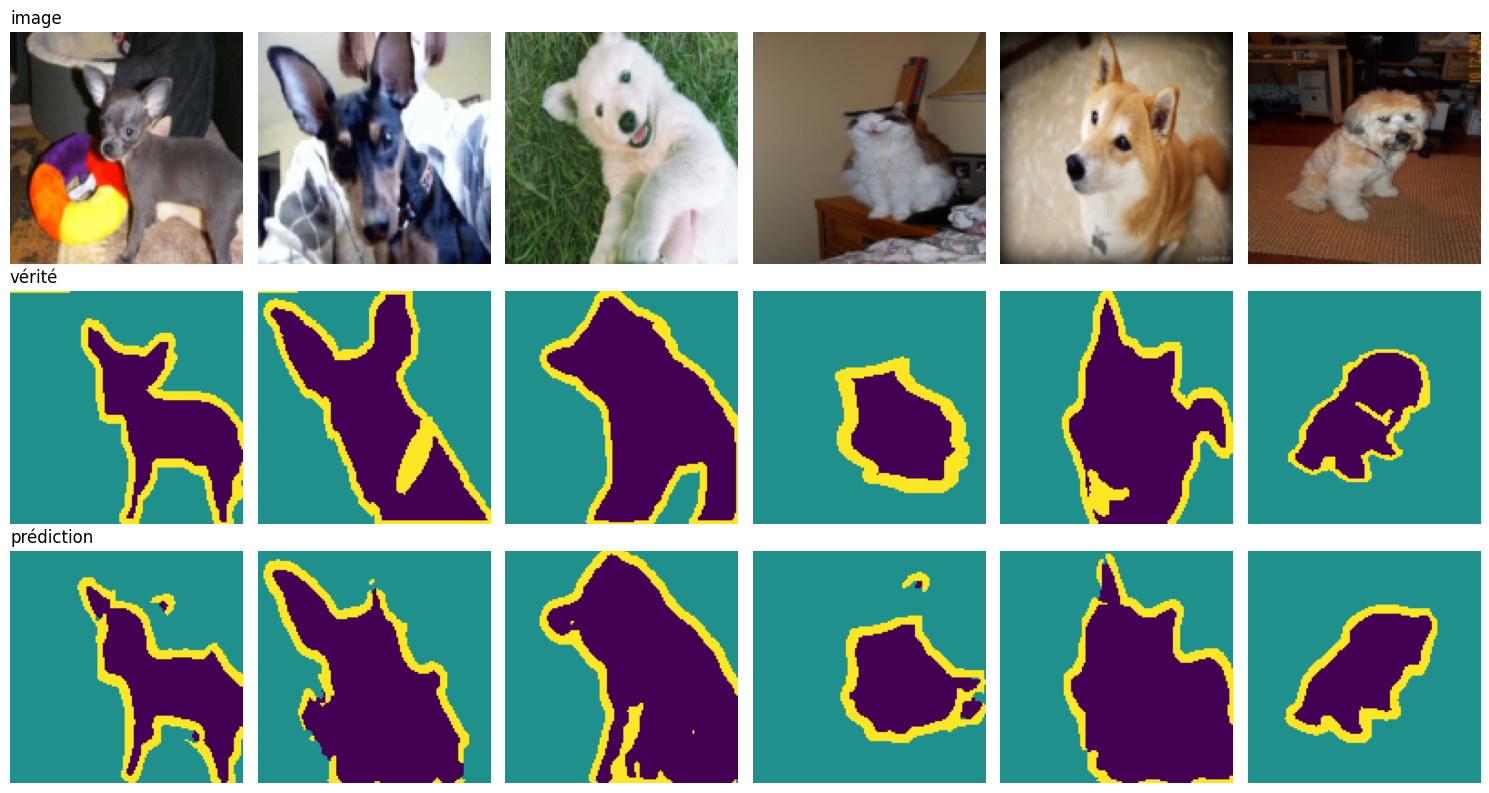
A three-notebook path: classical segmentation (thresholding, contours, K-means), layer-by-layer feature map visualisation, then a U-Net coded from scratch (DoubleConv, Down, Up) trained twice under identical settings, with and without skip connections, on Oxford-IIIT Pet (3 classes: animal, background, boundary).
- 05
The failure
Nothing dramatic, just the classic: shapes that did not match. Between poolings, transposed convolutions and skip concatenations, every level has to land on exactly the right size. A few dimension calculations later, the U was standing.
- 06
The discovery
Without skip connections, the network still roughly knows where the animal is (−0.031 IoU), but it can no longer draw its outline: boundary IoU drops from 0.471 to 0.375. Skip connections do not help the network see better, they help it remember where the details are.
- 07
The result
mIoU of 0.719 with skip connections versus 0.672 without, on 3,669 test images. Everything is documented as a course, in French and English.
- 08
The next frontier
Try other variants (attention gates, pretrained encoder), move to larger images, and apply segmentation to data that matters locally, such as agricultural or medical imaging.